Intermittent Refining

Product Overview
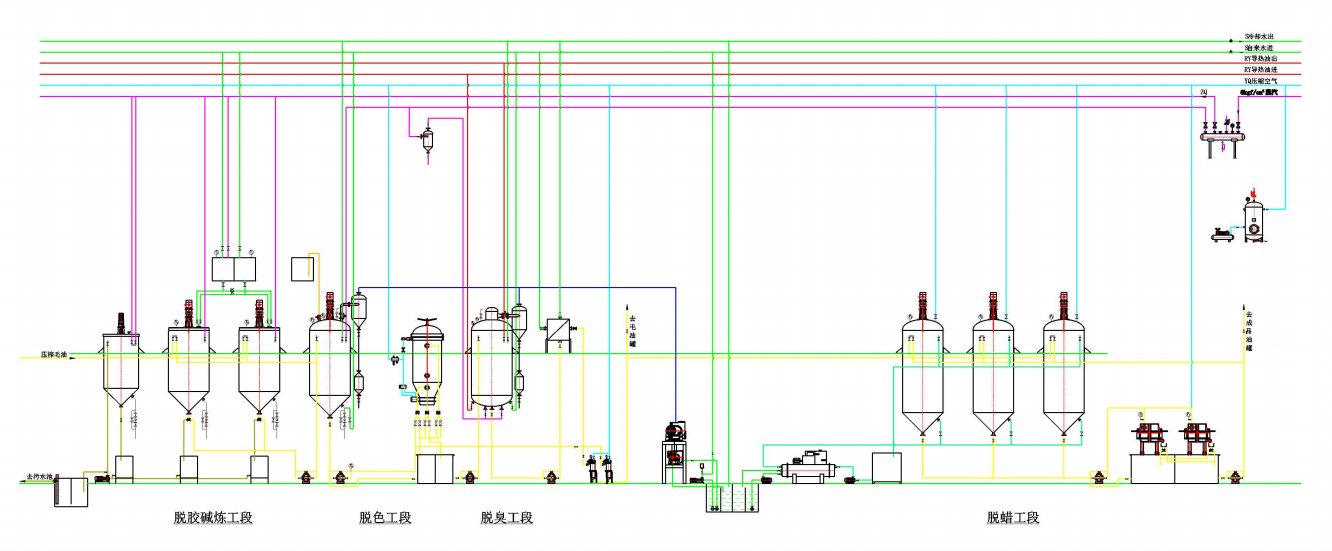
The refining system consists of equipment such as a refining pot, decolorization and drying pot, deodorization pot, soapstock pot, crystallization tank, filter, thermal oil heater, vacuum system, and refrigeration unit. Crude oil undergoes processes including degumming, deacidification, decolorization, dewaxing, and deodorization to produce oils ranging from Grade 1 to Grade 4.
The equipment is available in intermittent (below 50 T/D), semi-continuous (20–80 T/D), and fully continuous (above 30 T/D) models. Users can select the appropriate process and equipment based on their production scale and desired oil quality standards.
Intermittent Refining Process Flow and Description

Description of the Batch Refining Process Flow
Degumming and alkali refining >>
The clarified crude oil is pumped from the crude oil storage tank into the hydration kettle, where it is heated with low-pressure steam to a specific temperature. A phosphate solution (or brine) is added in precise proportions and thoroughly mixed. During this process, non-hydrated phospholipids in the oil are converted into hydrated phospholipids, facilitating their eventual removal. The oil then moves to the alkaline refining kettle, where a measured amount of caustic liquor is introduced and evenly blended. It’s subsequently heated to another controlled temperature before undergoing oil-soap separation. The resulting soapstock is first transferred to a soapstock tank for salting-out, which helps recover any residual oil trapped within the soap. Finally, the soapstock is pumped to a soapstock pool for storage.
After degreasing, the oil enters a water-washing tank and is mixed with hot water at a specific ratio. Here, a small amount of phosphoric acid solution (or brine) is also added to help remove residual soap and other impurities. Next, the oil undergoes water washing and separation to eliminate any remaining soap scum or other contaminants. Finally, the washed oil moves into a drying and decolorizing tank, where it’s first dried to remove moisture and other volatile substances, followed by the decolorization process.
Decolorization Section >>
Decolorization is the process of removing colored substances from oil, typically achieved by mixing the oil with an appropriate amount of decolorizing clay, which adsorbs the pigments and separates them from the oil during filtration. The decolorizing clay is stored in a clay tank and is introduced into the tank via vacuum-assisted suction.
The decolorization pot is an upright cylindrical vessel equipped with rounded, arc-shaped end caps at both the top and bottom. It must be well-insulated and maintained under vacuum, which is generated by a dedicated vacuum system. Gases extracted from the decolorization pot are routed through a cyclone separator to capture any oil droplets that may occasionally be carried along with these gases. Inside the decolorization pot, a stirring device ensures thorough mixing and contact between the bleaching earth and the oil, facilitating efficient pigment removal. Afterward, the mixture is cooled to below 70°C before being pumped into a vertical blade filter for further purification.
When the filter starts operating, the oil that is filtered out appears cloudy. Therefore, the oil is returned for re-filtration until it becomes clear and transparent. Once properly filtered, the oil flows into the clear oil tank and is then conveyed—either by vacuum self-suction or via a pump—to the deodorization section.
Deodorization Section >>
Decolorized oil enters the deodorization kettle, which operates under vacuum conditions. The oil is heated by thermal oil, and as direct steam is introduced, the oil is sprayed into a fine mist to effectively remove trace amounts of dissolved oxygen and volatile compounds—such as free fatty acids and various odor-causing substances—from the fat. The collected fatty acids are temporarily stored in a collector. Finally, once the deodorized hot oil is cooled to below 60°C, the refined, finished oil is ready.
Wax Removal Section >>
The deodorized oil is cooled to room temperature and then pumped into the crystallization tank, where it undergoes pre-cooling followed by freezing. During the crystallization process in the tank, a portion of the filter aid is added directly to the oil and evenly dispersed throughout via agitation from the mixer. This filter aid serves as nucleation sites for wax crystals, promoting the gradual precipitation and growth of wax components into larger, well-defined crystal particles. After an appropriate crystallization period, these crystals fully develop and take shape before being pumped into a plate-and-frame filter for filtration. At the start of filtration, the oil initially appears cloudy; therefore, the oil is returned to the filter until the filtrate becomes clear. Once the filtrate reaches clarity, the filtered oil is pumped into a final storage tank for temporary holding before further processing or distribution.
Intermittent Refining Process Flowchart